












When Prime Minister Narendra Modi recently spoke about avocados in Mann Ki Baat, I smiled.
He spoke about the growing popularity of avocado in India and, more importantly, about Indian farmers successfully cultivating it in Andhra Pradesh, Tamil Nadu and Karnataka. For many people, avocado may still seem like a relatively new, fashionable food in India.
My own relationship with avocado actually began in Toronto, when I was studying in Canada and I did not fall in love with it immediately like many Indians.
I knew avocado was nutritious, so I made myself eat it. It was expensive too, which made me wonder what all the fuss was about! The first couple of times, I wasn’t particularly impressed. But after eating it two or three times, something changed. I began appreciating that wonderful butteriness. And then I discovered guacamole. That was it. I was in love with avocado.
Later, when I was living in America, avocado became a very regular part of the way I cooked and ate. When my parents came to visit me, their reaction was almost exactly like mine had been. They didn’t care for it initially either.
Slowly, they began enjoying it in salads. It was soft, creamy and made a plate of raw vegetables much easier and more satisfying to eat. Before long, avocado had become one of my father’s favourite foods. One combination that he absolutely loved was a grilled portobello mushroom with avocado, a slices of tomato and onion, all tucked into good sourdough bread. That was his favourite, favourite sandwich. Later, when I began serving avocado alongside pesarattu, my parents enjoyed that combination too and it remains one of my own favourite ways to eat avocado today.
By then I was living in Florida, where my understanding of avocado expanded enormously. When we say “avocado” today, most people immediately picture the small, dark, pebbled Hass avocado. But avocado is not one single-looking fruit. During my years in Florida, I must have personally used more than twenty different types. There were tiny ones and enormous ones almost the size of a coconut. There were round ones, pear-shaped ones and wonderful long-necked avocados that almost looked like bottle gourds. Some were deep green, some beautiful emerald shades. Some had yellowish flesh, others green flesh. Some were extremely buttery and rich, while others were much lighter and contained more water.
When I eventually returned to India and during the birth of Vibrant Living, I remember having one slightly ridiculous worry: How am I going to run a vegan kitchen in India without avocados and good olive oil? At that stage, I thought those two ingredients made almost everything taste better, particularly in a plant-based kitchen.
Of course, India very quickly reminded me of what we already had. I rediscovered millets, dals, coconuts, seeds, native grains, vegetables, greens and our extraordinary traditional food wisdom. I realised that I could create an abundant vegan kitchen around foods that belonged naturally to this land. And then came the avocado surprise.
Vibrant Living was still just beginning to take shape as an idea aroud 2009 when I visited Coorg. One early morning, I was walking in Madikeri with my cousin when I suddenly saw a tree oaded with avocados. I cannot describe how exciting that sight was to me. Here was this fruit I had been wondering how I would live without, growing abundantly in Karnataka.
Except nobody there called it avocado. It was butter fruit. n Karnataka, it is also commonly known as benne hannu, literally, butter fruit. And then came another surprise. When I asked people what they did with it, the answer was usually: not very much. The familiar preparation seemed to be a butter-fruit milkshake which is ripe avocado blended with milk and sugar. Sometimes people mashed it with sugar, honey or jaggery. Much later, somebody told me that they would also make a simple savoury preparation with a tadka. But it certainly didn’t appear to be an ingredient that people were using in dozens of everyday dishes. What a pity!
Here was this magnificent creamy fruit growing on large trees in South India, and yet it had never entered our everyday culinary vocabulary. In fact, avocado has been growing in southern India for well over a century. It became established in areas including Karnataka, the Nilgiris and Kodaikanal, often as scattered trees or as a secondary crop rather than a major organised commercial crop.
So in many ways, India had avocado trees long before India developed an avocado culture. And coming from Florida, I looked at these butter fruits and saw possibilities everywhere. Why only milk and sugar? Why not salads, smoothies chutneys, savoury spreads, dressings, dips, cold soups, fillings, desserts and puddings like I did living abroad.
Once Vibrant Living began, I was fortunate to have a Coorgi friend who helped source avocados for us. She was so generous to send boxes and boxes of them. They would arrive from Karnataka, and we would be thrilled.
Over the years at Vibrant Living, we have used avocado in almost every way imaginable. Of course there was guacamole. We put avocado into smoothies, sandwiches and salads. We made creamy dressings, spreads, cold soups, desserts, puddings served alongside curries and dals. Topped on pulusus even, We used avocado halves as beautiful little natural cups and filled them with savoury pâtés and other fillings. Serve with our flax seed crackers, millet crackers and more. The ways to enjoy avocado is endless.
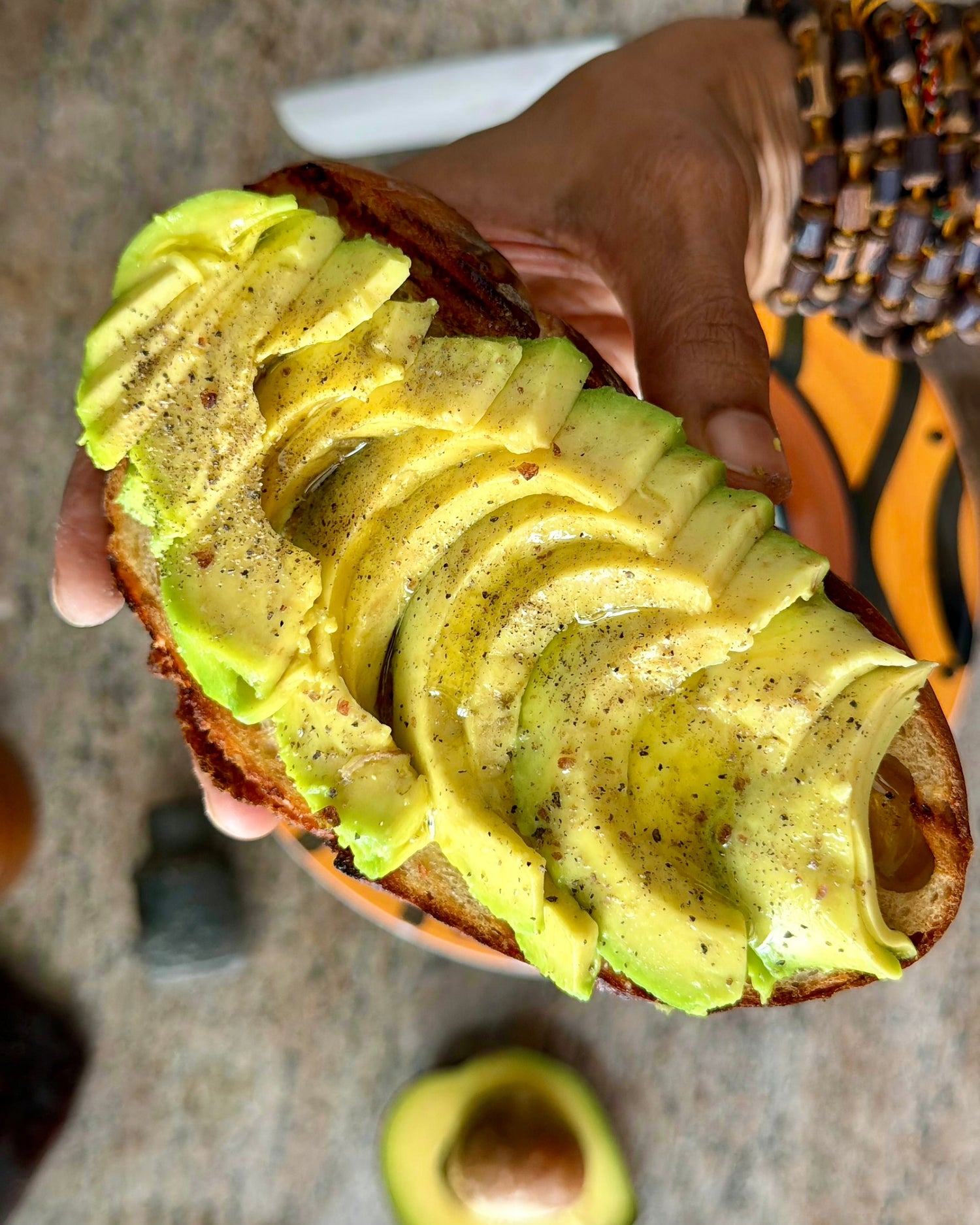
And, of course, there is my avocado and pesarattu. The warm, earthy flavour of a moong pesarattu with creamy avocado works so beautifully. Another favourite discovery of mine is wonderfully simple: mash a ripe avocado with a little black salt and good olive oil and put it on sourdough toast. Somehow, it gives you that savoury satisfaction reminiscent of egg on toast that is entirely plant-based.
Avocado even follows me when I travel. Many years ago, I had a friend who ate only raw food. When we went to restaurants, she would sometimes arrive with a couple of avocados in her handbag. Whatever simple salad or vegetables the restaurant could provide, she would add her avocado and suddenly have a substantial meal. I used to find it amusing. Now I find myself doing much the same thing. When I travel, an avocado can transform a simple salad, some vegetables or good bread into something much more satisfying.
That satisfaction is one of the reasons avocado is valuable nutritionally too. It provides fibre together with predominantly unsaturated fats, which can bring richness and satiety to a meal. And satiety matters. Healthy food should not leave you constantly searching for something else to eat.
But there is another side to my avocado story in India and anyone who has worked seriously with locally grown avocados will understand this.
Local avocados can be unpredictable.
An avocado is unusual because it matures on the tree but softens only after it has been harvested. Knowing exactly when to harvest therefore matters enormously. If it is picked too immature, it may remain rubbery, shrivel or simply never develop the beautiful creamy texture we are waiting for.
Indian horticultural guidance itself stresses the importance of harvesting avocado at the correct stage of maturity because immature fruit does not ripen properly after picking.
And because much of our avocado cultivation historically developed through scattered trees and seed-grown plants, there can also be tremendous variation from tree to tree. This is something we have dealt with at Vibrant Living for years.
You may receive a beautiful box of local avocados and wonder: How many will ripen properly? Which ones will stay hard? Which ones will suddenly spoil before they soften?
Sometimes it is very frustrating. That partly explains why imported Hass avocados have become so attractive to chefs and consumers.
Hass has a naturally rich, high-oil flesh and, because it is a standardised commercial variety supported by a very developed harvesting, packing and ripening industry, what arrives in the market tends to be much more predictable. Hass is known for its relatively high oil content, while Indian selections themselves vary considerably, for example, ICAR describes Arka Supreme at around 20% fat and Arka Coorg Ravi at around 12–14%. (Indian Council of Agricultural Research)
For a professional kitchen, reliability is enormously tempting.
But then I look at how far that avocado has travelled. And that bothers me. For that reason we didn’t put avocado related dishes on our menu. We only served them for our meal subscriptions clients as menu was planned each week.
I keep looking for good growers, better sources and people who understand when to harvest. We have been encouraging farmers to grow avocado for years. And now we are growing avocado ourselves here in Hyderabad and our trees are fruiting beautifully.
That gives me enormous joy. I don’t think the answer is to abandon local avocado because imported Hass is easier. I think the answer is to get better at growing, selecting, harvesting and handling our own avocados.
India already has promising selections. ICAR-IIHR has developed varieties such as Arka Supreme and Arka Coorg Ravi, demonstrating that there is enormous potential to select Indian-grown fruit for yield, pulp recovery, richness and quality.
This is why Prime Minister Modi talking about Indian avocado cultivation feels significant to me. I hope increasing demand doesn’t simply result in us importing more avocado from thousands of kilometres away. I hope it encourages us to look at what is already growing here.
I would love to see growers in suitable parts of Karnataka, Andhra Pradesh, Telangana, Tamil Nadu and other appropriate regions experiment intelligently with avocado, with the right cultivars, horticultural guidance and understanding of local climate.
And I would love consumers to understand that our local avocado may not always look like Hass. It may be larger. It may remain green when ripe. It may contain a little more water or a little less fat. It may taste different. That doesn’t make it an inferior avocado. It makes it a different avocado.
Perhaps, as our cultivation matures, we will begin seeing the kind of diversity I remember from Florida — different varieties for different purposes, some rich and creamy, some light and fresh, some wonderful for salads, some perfect for spreads.
There is something wonderfully circular about all of this for me. I first discovered avocado as a student in Toronto and didn’t even particularly like it. Then I fell in love with guacamole. My parents went through almost the same journey, until avocado became one of my father’s favourite foods. I moved to Florida and discovered an entire world of avocado varieties. I returned to India wondering how I could possibly create a vegan kitchen without them.
India first taught me that I didn’t need avocado at all — that our millets, dals, coconuts, seeds, vegetables and traditional foods offered extraordinary abundance. And then, on a morning walk in Madikeri, India surprised me again. The avocado had been here all along. We simply called it butter fruit.
So eat your millets. Eat your pesarattu and dals and seasonal vegetables. And when good locally grown avocado is available, welcome that to the table too.
Put it beside your pesarattu. Make a chutney. Add it to a salad. Blend it into a dressing or soup. Make a pudding. Spread it onto sourdough. Fill it with something savoury. Or simply cut it open, add lime and salt and eat it with a spoon.
And if you live somewhere where the climate is right and you have the space, perhaps plant a tree. One day you may walk outside and see it covered with avocados. I can still remember exactly how I felt when I saw that tree in Madikeri all those years ago.
I think I would be just as excited today.
Btw, we have locally grown avocados on sale in our shops in Hyderabad. Many dishes with avocado are on our menu and many recipes are shared on our youtube channel too. Please check them out and enjoy this deliciously healthy food whenever you can.
— Sridevi Jasti
Founder, Vibrant Living


