













Mother's Love in a Bowl
If someone had told me ten years ago that one of my favourite meals would become a humble bowl of khichdi, I probably would have smiled politely and moved on.
Growing up in coastal Andhra, khichdi was never a part of our family table. Like many South Indian homes, ours revolved around rice, dals, vegetables, pulusus, charu (rasams) and an array of seasonal dishes. Khichdi, if I thought about it at all, was something people ate when they weren't feeling well. It certainly wasn't something I associated with celebration, comfort or delicious food.
Life has a wonderful way of changing our perspectives.
After spending over two decades abroad, living in Toronto, Italy and Florida, I returned to India with a renewed curiosity about our own food traditions. I had spent years learning about cuisines from around the world, understanding ingredients, techniques and food cultures. Yet, some of India's simplest foods still had lessons to teach me.
One of those lessons came in the form of khichdi.
About eight years ago, I had the opportunity to undergo a 21-day Panchakarma programme. The idea had been in my mind for a long time. An Ayurvedic doctor, who had once come to Vibrant Living as a client, noticed some skin issues in bottom part of my legs and suggested Panchakarma. I too was curious for a longtime about it so I made a mental note to make it happen one of these days though I hesitated as the therapies sounded intense. Eventually, the right opportunity presented itself, and I decided to embrace the experience wholeheartedly.
During Panchakarma, the diet becomes intentionally simple. Your digestive system is given the opportunity to rest while still receiving complete nourishment. Khichdi became one of my regular meals, and at first I wondered how anyone could eat it so often. Wouldn't I get bored? Wouldn't I start craving something more exciting?
Instead, something entirely unexpected happened.
Every morning I woke up feeling light. My digestion felt effortless. There was a steadiness to my energy that I hadn't experienced before. Meals never left me feeling heavy or sluggish, and I slept deeply every night. Of course, Panchakarma is a complete healing experience, and I have no doubt that every therapy contributed to how I felt. But there was something about that warm bowl of khichdi that stayed with me long after the programme ended.
It was comforting, satisfying and nourishing without demanding anything from my body.
That was the moment I truly understood why this simple dish has been treasured for centuries.
More Than Comfort Food
To me today, khichdi is mother's love in a bowl.
It is warm, comforting and reassuring. It asks for very little, yet gives so much in return. It doesn't rely on rich gravies or elaborate spices to impress us. Instead, it nourishes us, leaving us feeling cared for from within.
In a world where we are constantly searching for the next superfood, I sometimes wonder if we overlook the wisdom that has been sitting in our own kitchens all along.
Khichdi may not arrive with clever marketing or exotic packaging, but it has something much more valuable. It has stood the test of time.
Across India, every region has its own interpretation. Some prepare it with rice, others with millets. Some keep it very simple, while others fill it with seasonal vegetables. It has comforted children, nourished the elderly, supported people recovering from illness and become the meal of choice after periods of fasting or cleansing.
Perhaps there is a reason it has survived for thousands of years.
Why Ayurveda Loves Khichdi
One of the most beautiful things about Ayurveda is that it doesn't simply ask whether a food is nutritious. It asks whether your body can digest and assimilate it with ease.
After all, even the healthiest meal has little value if our body struggles to digest it.
Khichdi answers that question beautifully.
Traditionally prepared with grains and moong dal, it provides a balanced combination of carbohydrates and protein in a form that is gentle on the digestive system. Moong dal has long been appreciated in Ayurveda because it is considered one of the easiest dals to digest. When paired with rice or millets, seasonal vegetables and a thoughtful tempering of spices, it becomes a complete meal that nourishes without overwhelming. There is no garlic or onion making it suitable for many people who follow a Jain diet.
This is also one of the reasons khichdi is often described as a sattvic meal.
Sattvic foods are those that promote balance, clarity and harmony. They are gentle on the body and the mind. Whether you are recovering from illness, completing a fast, supporting digestion or simply looking for a light evening meal, khichdi has a remarkable ability to leave you feeling nourished rather than weighed down.
I experienced this myself during Panchakarma, and I experience it every time I return to it.
Breaking a Fast
A few years after Panchakarma, during Navratri, we decided to offer evening khichdi dinners at Vibrant Living for those breaking their fast.
Every evening, a different khichdi would emerge from our kitchen. Some days it featured brown rice, while on others it celebrated little millet, quinoa or heirloom rice varieties. Seasonal vegetables changed with nature's rhythm, making every bowl a little different from the one before.
Along with our guests and some colleagues, I too enjoyed those dinners.
After an entire day of fasting, breaking the fast with khichdi felt almost divine.
There was no heaviness, no discomfort and no feeling that I had overeaten after a day without food. Instead, there was gratitude. Gratitude for the simplicity of the meal, the care that had gone into preparing it and the satisfaction that lingered long after dinner was over.
Those evenings convinced me that khichdi deserved a permanent place at Vibrant Living.
Not because it was fashionable nor because Ayurveda recommended it.
But because of how beautifully it made people feel.
Our Khichdis at Vibrant Living
When we introduced khichdi into our meal subscriptions a few years ago, we didn't want to serve the same bowl every week. One of the greatest joys of cooking with whole foods is that every season brings new possibilities, and khichdi reflects that beautifully.
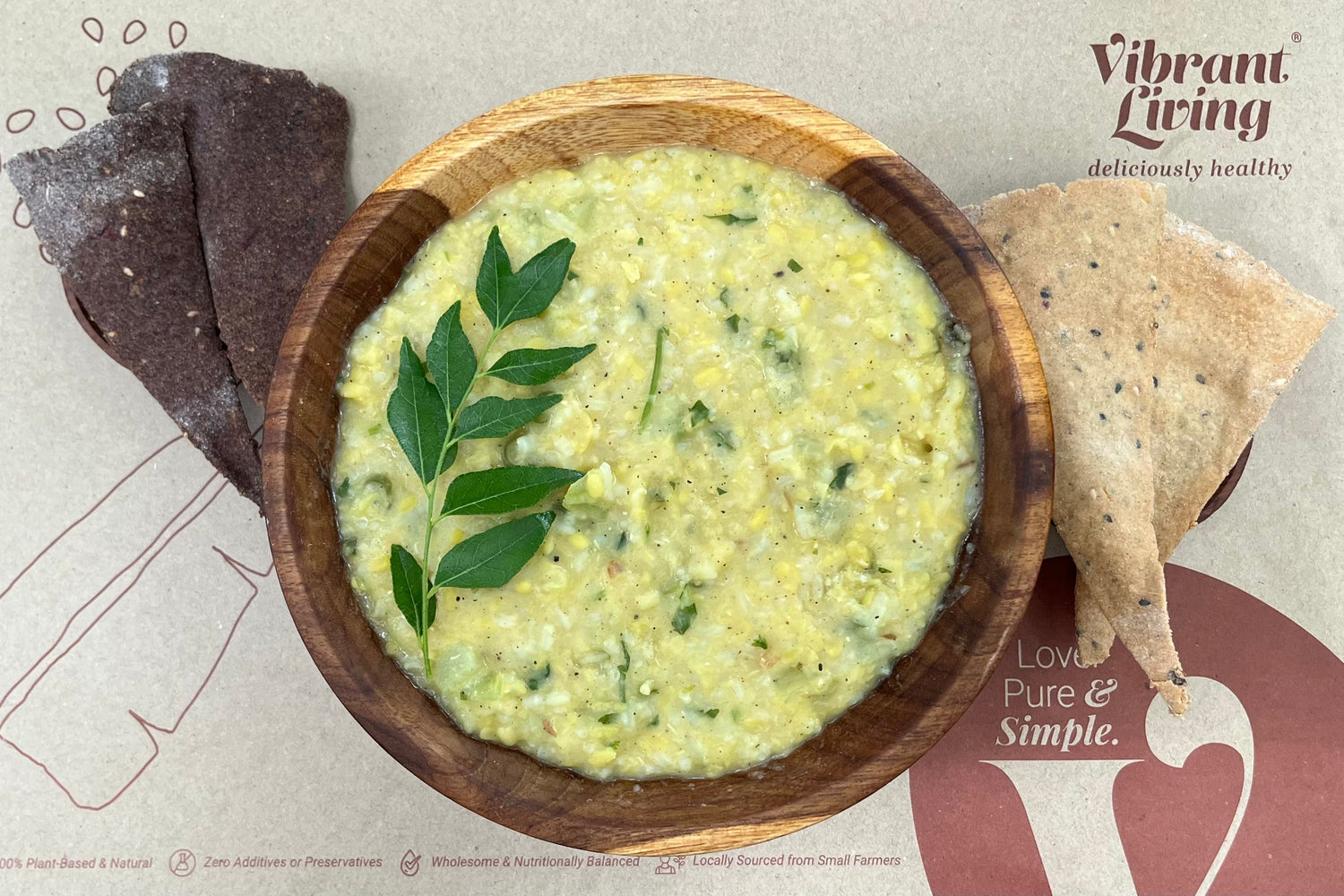
At the heart of every bowl is moong dal, but the grains are constantly changing. Depending on the day, we may use wholesome brown rice, black rice, red rice, fragrant heirloom varieties such as Chitti Muthyalu or Mysore Mallige, quinoa, little millet, bajra, jowar, proso millet or other traditional grains. Each brings its own flavour, texture and nutritional character.
The vegetables change just as naturally. We use whatever the season offers us at its best—pumpkin, bottle gourd, carrots, beans, sweet potatoes, fresh greens and many other vegetables. Rather than cooking everything together until it loses its identity, we add each vegetable according to its cooking time. Tender greens go in towards the end so they retain their beautiful colour, delicate texture and freshness.
The result is a bowl that is nourishing, colourful and deeply satisfying, while remaining wonderfully gentle on the stomach.

The Magic Lies in the Tadka
As much as I love the grains and vegetables that go into our khichdis, I have to admit that my favourite moment is the tadka.
There is something almost magical about watching coconut oil warm gently in the pan before the cumin seeds begin to crackle. Fresh curry leaves release their unmistakable aroma, turmeric lends its beautiful golden hue, freshly cracked black pepper adds gentle warmth, and the cashews turn lightly golden. Then comes the ingredient that quietly transforms the entire dish, a tiny pinch of pure hing.
Many people are surprised to learn that hing, or asafoetida, despite being such an integral part of Indian cooking, is not traditionally grown in India. It is the dried resin of the Ferula plant, native to regions such as Afghanistan and Iran. For centuries, it has travelled along ancient trade routes into Indian kitchens, where it has become indispensable, especially in vegetarian cooking.
At Vibrant Living, we use pure Afghan hing rather than compounded hing, which often contains flour and other fillers. Pure hing has a depth of flavour and aroma that only a tiny quantity is needed to transform an entire pot of food. It also has a long history in traditional Indian cooking for supporting digestion, especially in meals centred around dals and legumes.
It is one of those humble pantry ingredients that rarely receives the appreciation it deserves. Once you begin cooking with good-quality hing, it is difficult to go back. In fact, it has become such an important ingredient in our own kitchen that we now make it available in our shops for those who would like to experience the difference in their own homes.

A Bowl That Nourishes Completely
One of the reasons I appreciate khichdi so much today is because it is nutritionally elegant.
Every spoonful brings together whole grains or millets, protein-rich moong dal, colourful seasonal vegetables, healthy fats, fibre and thoughtfully chosen spices. There is no need to complicate it further. Nature has already done the balancing for us.
The combination of grains and moong dal provides complementary proteins. The vegetables contribute vitamins, minerals and antioxidants, while the fibre supports digestive health and helps us feel comfortably satisfied. The spices do much more than flavour the dish. Cumin, turmeric, black pepper, ginger and hing have all been treasured in Indian kitchens for generations, not only because they taste wonderful but because they gently support digestion and overall wellbeing.
Perhaps this is one of the reasons khichdi feels so satisfying at dinner. It nourishes without leaving us feeling overly full. Instead of going to bed with the heaviness that often follows a rich evening meal, many people experience a sense of lightness and comfort. I certainly do. I often wake up the next morning feeling refreshed, energetic and ready to begin the day.
Good nutrition is not always about eating less or counting calories. Sometimes it is simply about choosing foods that our bodies know how to use well.

More Than a Recipe
People often ask us for our khichdi recipe, and we are always happy to share it. In fact, one of our favourite khichdi recipes is already available on our YouTube channel and Instagram for anyone who would like to recreate it at home.
But I have come to realise that khichdi is much more than a recipe.
It is a way of cooking.
It teaches us to cook with the seasons instead of against them. It reminds us that a meal does not need twenty ingredients to be nourishing. It encourages us to use what is growing around us, to appreciate traditional grains, to value simple spices and to trust that some of the most wholesome meals are also the simplest.
Every pot of khichdi tells a slightly different story because every season tells a different story.
A Complete Meal, Thoughtfully Served
At Vibrant Living, we wanted our khichdi to feel like a complete and joyful meal rather than just a bowl of rice and dal.
That is why every serving is accompanied by crunchy millet crackers, which change depending on what we are making. Some days they may be prepared with ragi and sesame, while on other days they may feature jowar or other wholesome grains. Alongside them are roasted chickpeas that add another layer of texture and protein, and our fresh ginger relish, whose bright, vibrant flavour beautifully complements the gentle comfort of the khichdi.
The contrast of warm and cool, soft and crunchy, mild and lively makes the meal feel satisfying in every way.
Simple food never has to be boring.
Why It Has Become Part of Vibrant Living
When we first introduced khichdi into our meal subscriptions, I wasn't sure how people would respond. After all, many of us still associate it with illness or recovery.
The response surprised us. People loved it.
Many wrote to tell us how comforting it was after a long day at work. Others shared that it had become their favourite dinner because they slept better afterwards. Some appreciated not having to think about preparing a wholesome evening meal after a busy day. Others simply enjoyed discovering how delicious khichdi could be when made with thoughtfully chosen ingredients and seasonal vegetables.
Today, it has become one of the meals that represents what Vibrant Living stands for.
Not elaborate. Not complicated. Just wholesome, honest food prepared with care.
Rediscovering an Ancient Wisdom
We spend so much time searching for the latest superfood that we sometimes overlook the wisdom that has always existed in our own kitchens.
Khichdi may never become the trendiest dish on social media, and perhaps that is perfectly fine.
It has never needed clever marketing.
It has survived because it works.
For centuries, it has nourished children, comforted families, supported people during recovery, sustained those observing fasts and found its place on dinner tables across India.
Every generation has rediscovered it in its own way. I certainly did.
What I once considered "simple food" has become one of the meals I cherish the most.
Today, whenever I sit down with a warm bowl of khichdi, I am reminded that food does not need to be extravagant to be extraordinary. Sometimes, the greatest nourishment comes from the simplest ingredients, prepared with patience, respect and love.
If this article inspires you to make a pot of khichdi at home, I hope you'll try our recipe on YouTube or Instagram. And if you would rather let us do the cooking, our seasonal khichdis are served at Vibrant Living, featured regularly in our evening meal subscriptions, and available for you to enjoy whenever you need a wholesome, comforting dinner.
Who knows? Like me, you may discover that one of India's oldest dishes is also one of its greatest gifts.
After all, to me, khichdi will always be mother's love in a bowl.
There is one more reason khichdi holds a special place in my heart.
My mother, who enjoys her dinners from Vibrant Living almost every day, chooses our khichdi more often than anything else. Every time I see her happily finishing a bowl, I am reminded that food doesn't have to be elaborate to be deeply satisfying. Knowing that something we prepare in our kitchen has become my own mother's favourite evening meal is perhaps one of the greatest compliments I could receive.
It feels as though life has come full circle. The dish that I once overlooked has become the one that nourishes both my family and the extended Vibrant Living family.
Perhaps that is the beauty of khichdi. It doesn't ask for attention. It simply finds its way into your heart, one comforting bowl at a time.


